
Criminal Cases in the Marion County Courts
Marion County divides criminal files by the level and source of the charge. The 115th District Court hears felonies, and the District Clerk keeps those cause files. The constitutional Marion County Court handles its Class A and Class B misdemeanor jurisdiction through the County Clerk. Justice of the Peace Precincts 1 and 2 keep their own fine-only and precinct matters. Jefferson Municipal Court holds city ordinance cases and fine-only state-law cases filed there. Appeals from Marion County trial courts go to the Sixth Court of Appeals.
The official Marion County office directory shows how those record holders are split across the courthouse and nearby offices. It is a useful first check when the issuing agency or charge level is known.
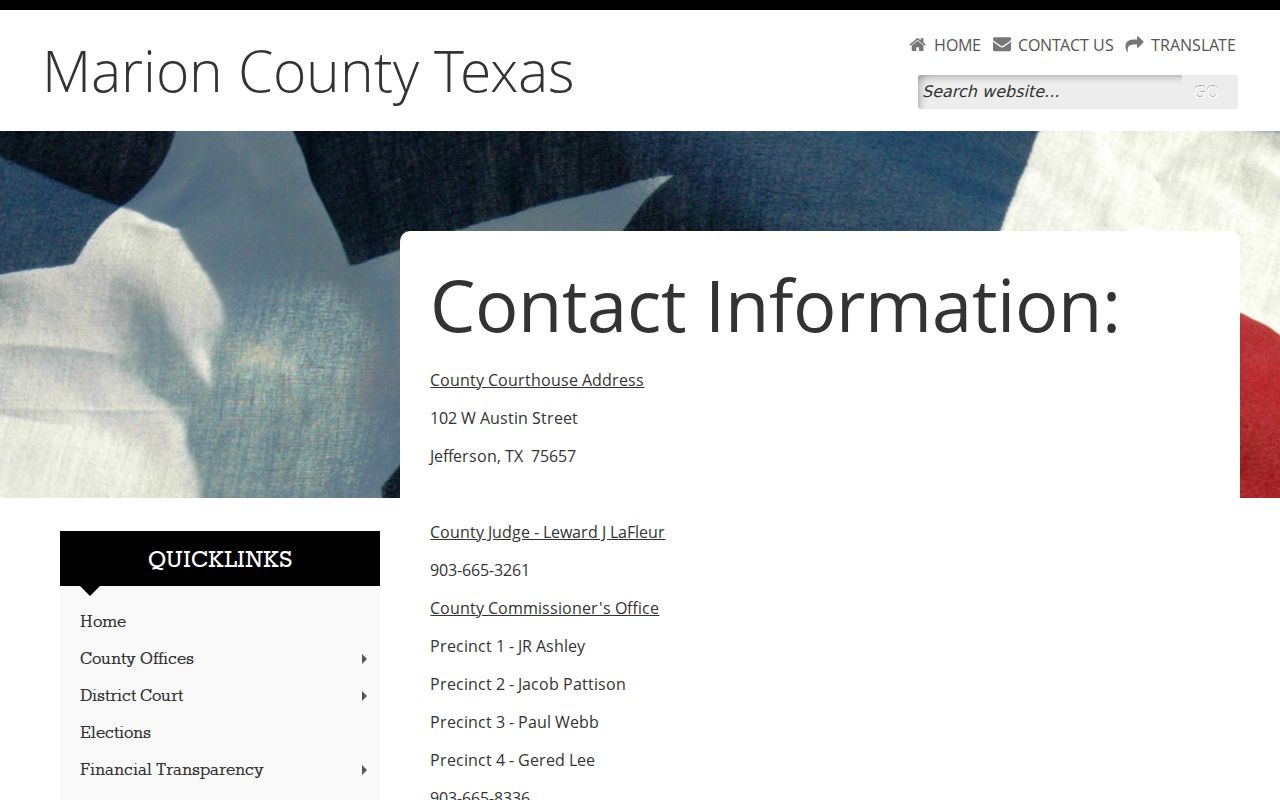
The directory view reinforces why one phone call cannot cover every Marion County court file. Each clerk controls the docket created in that clerk's court.
Choose the Marion County Court Clerk
Use the filed charge, not the arrest label alone, to choose a Marion County clerk. A booked charge is the allegation recorded at intake. A prosecutor may change it before filing. For a felony cause, call District Clerk Susan Anderson at 903-665-2441 or visit Room 303, 102 W. Austin Street in Jefferson. Mail may be addressed to P.O. Box 628, Jefferson, Texas 75657. For a County Court misdemeanor, call County Clerk Kim Wise at 903-665-3971.
Fine-only matters stay lower in the system. JP Precinct 1 is at 114 W. Austin, Room 204, and answers at 903-665-2392. JP Precinct 2 is at 8249 SH 49 and answers at 903-665-3581. A Jefferson citation belongs with the municipal clerk, not the District Clerk. The city payment site takes payments, but research did not verify it as a docket or document search. The full Jefferson criminal history route explains the city-level handoff.
How to Search Case Records
No free countywide criminal-case name index was found on the Marion County website. The working search method is a focused clerk inquiry. Begin with as much identity and case detail as possible, then ask for the docket before ordering many filings.
- Identify whether the matter is a felony, county misdemeanor, justice-court charge, or Jefferson municipal case.
- Call the matching clerk with the full name, approximate filing date, and cause number if known.
- Ask for the docket sheet or register of actions so the filed charge, settings, and status can be checked first.
- Select the complaint, information, indictment, order, judgment, or other filing needed from that index.
- Ask whether the copy can be sent remotely, whether an older paper file needs in-person inspection, and what plain or certified copies cost.
The Marion County District Clerk page confirms the felony-file counter and contact details used in that first route.
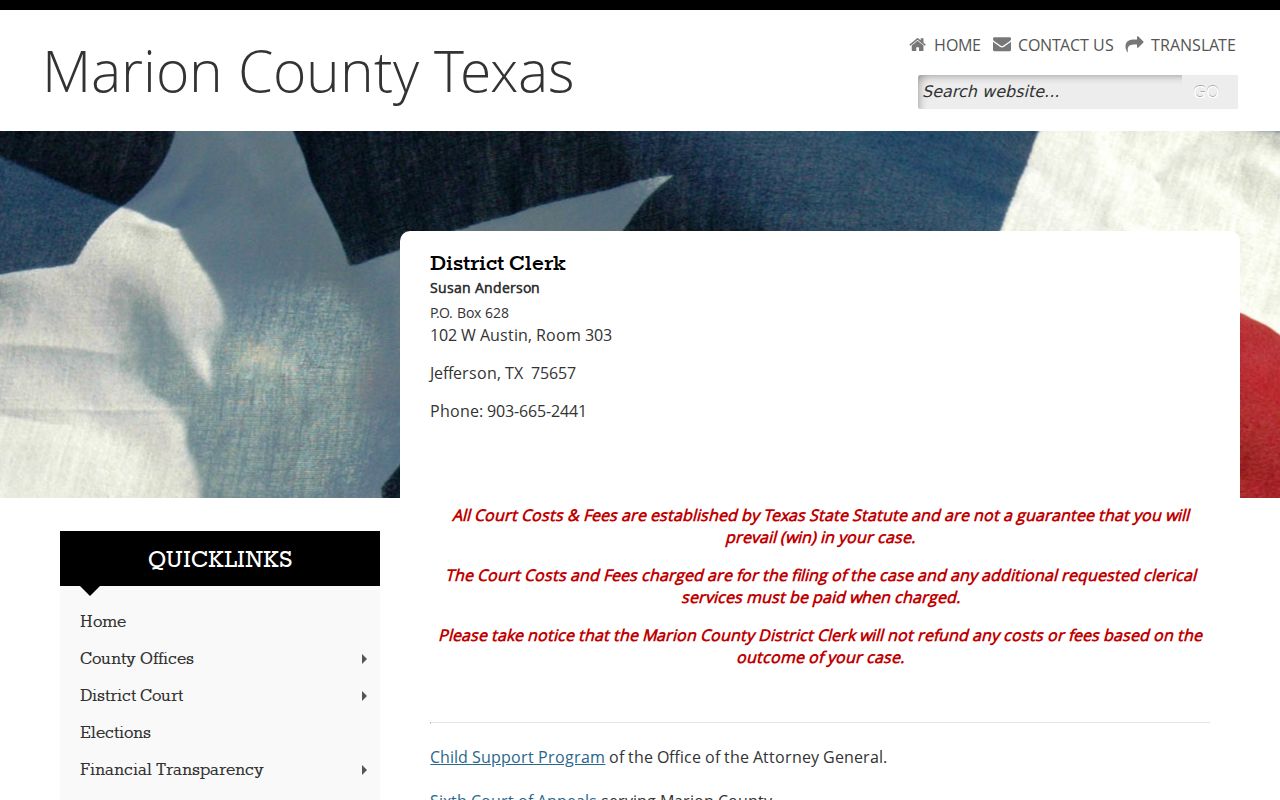
That local counter is the operative access point when a Marion County felony docket cannot be found online.
re:SearchTX Excludes Marion Criminal Cases
re:SearchTX is a statewide court-document portal, but it is not a Marion County criminal-case database. The Texas Judicial Council's 2024 Data Committee report says the portal's large document collection excludes criminal case records. A failed image capture of the portal also left no usable page image for this project. More importantly, the source limitation means a blank re:SearchTX result cannot show that a Marion County charge or file does not exist.
| Interface area | What the portal offers | Marion criminal limitation |
|---|---|---|
| Cases | Case detail for included material | Criminal cases are excluded |
| Filings | Filing detail and documents carried by the portal | No Marion criminal file substitute |
| Text | Keyword and advanced text search | Cannot search excluded criminal documents |
| Hearings | Hearing information for included records | Call the local clerk for criminal settings |
| Filters, saved search, export | Tools to narrow and retain included results | Filters cannot restore an excluded record class |
Use the portal only for material it actually carries. For Marion County criminal records, return to the District Clerk, County Clerk, proper justice court, or Jefferson Municipal Court.
What the Case File Shows
A Marion County criminal case file is organized by cause number and docket events. It can show what the prosecutor filed, how the court handled the charge, and the exact outcome. That makes it more useful than a booking profile when the goal is to distinguish a dismissal, acquittal, deferred adjudication, or conviction.
| Cause number and court | Identifies the local court and the file used for later requests. |
|---|---|
| Charging document | Shows the complaint, misdemeanor information, or felony indictment and the filed charge. |
| Docket entries | Lists filings, court events, attorney entries, bond or capias events, and register-of-actions text. |
| Hearing dates | Records settings and hearings entered by the court. |
| Disposition and judgment | States whether the charge ended in dismissal, acquittal, deferred adjudication, or conviction. |
| Sentence and conditions | May show confinement, fines, costs, restitution, or community-supervision terms. |
Some identifiers and documents will not be public. Social Security numbers, full driver's-license data, victim or minor identifiers, juvenile information, and sealed material may be removed or withheld.
Marion Court Charges and Prosecution
The arrest event and the filed Marion County charge are separate points in the record flow. A complaint can start the judicial trail. A prosecutor may file an information for a misdemeanor, while a grand jury may return an indictment for a felony. The District Attorney's office occupies Room 201 at 102 W. Austin Street and can be reached at 903-665-2611, but the clerk remains the custodian for the court's cause file.
The official Marion County District Attorney page identifies the local prosecution office connected to that charging stage.
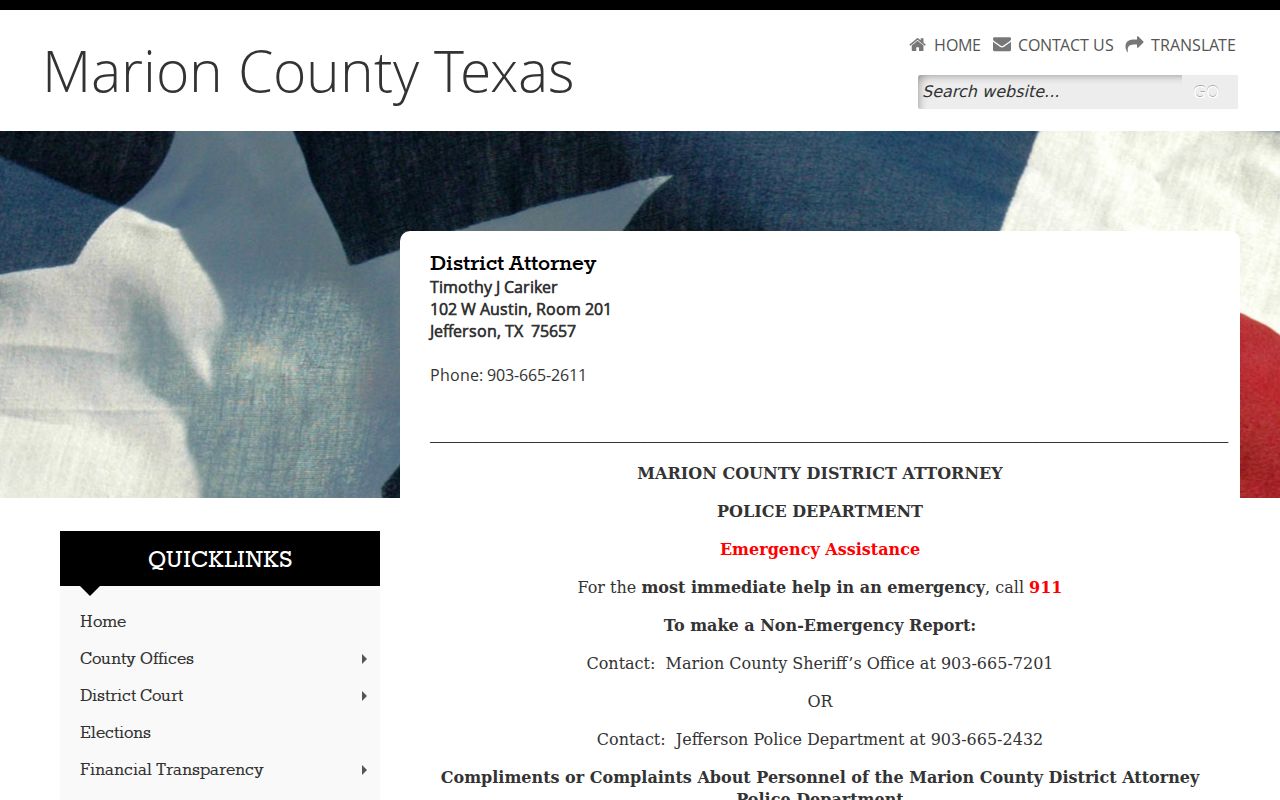
The distinction matters when reading a Marion County case: the prosecutor advances the charge, but the court docket records what was filed and what the judge did.
Stages of a Criminal Case
A Marion County cause builds in sequence, and each step can create a docket entry or document. Magistration addresses warnings, probable cause, and bond after an arrest. Prosecutor screening then determines what charge, if any, moves forward. Texas law generally calls for an arrested person to be taken before a magistrate without needless delay, ordinarily within 48 hours, but that rule is not a forecast of when the whole case will end.
Case flow: Charges Filed › Arraignment › Pretrial › Plea or Trial › Disposition › Sentencing
After sentence, the file may also show supervision, enforcement, or post-judgment events. An appeal moves to the Sixth Court of Appeals, whose docket is separate from the trial clerk's file.
Read Marion Court Dispositions Precisely
A status such as “closed” or “disposed” says that the court finished a stage or resolved the cause. It does not say how the charge ended. Read the judgment and disposition entry together. This is vital in Marion County court research because an arrest can remain part of the record even when the filed charge was later dismissed.
- Dismissal
- The charge ended without a conviction on that count.
- Acquittal
- The court or jury made a not-guilty determination after adjudication.
- Deferred adjudication
- The court deferred a finding of guilt while community supervision was completed; public DPS history may report it.
- Conviction
- The case ended in a judgment of guilt.
- Nolle prosequi
- The prosecutor formally decided not to continue with a charge.
When one word is unclear, request the signed order or judgment rather than drawing an outcome from the summary label.
Older Marion County Court Files
An older Marion County criminal case may exist only in paper or archive holdings. If nothing is online, call the correct clerk with the name, likely court, and a narrow filing-year range. Ask staff to confirm the cause number and request the docket sheet first. Then identify the exact filing or signed order needed. The clerk can say whether remote delivery is available or whether inspection at the office is required.
The Marion County justice-court page documents the separate JP contacts and request channels for fine-only matters.
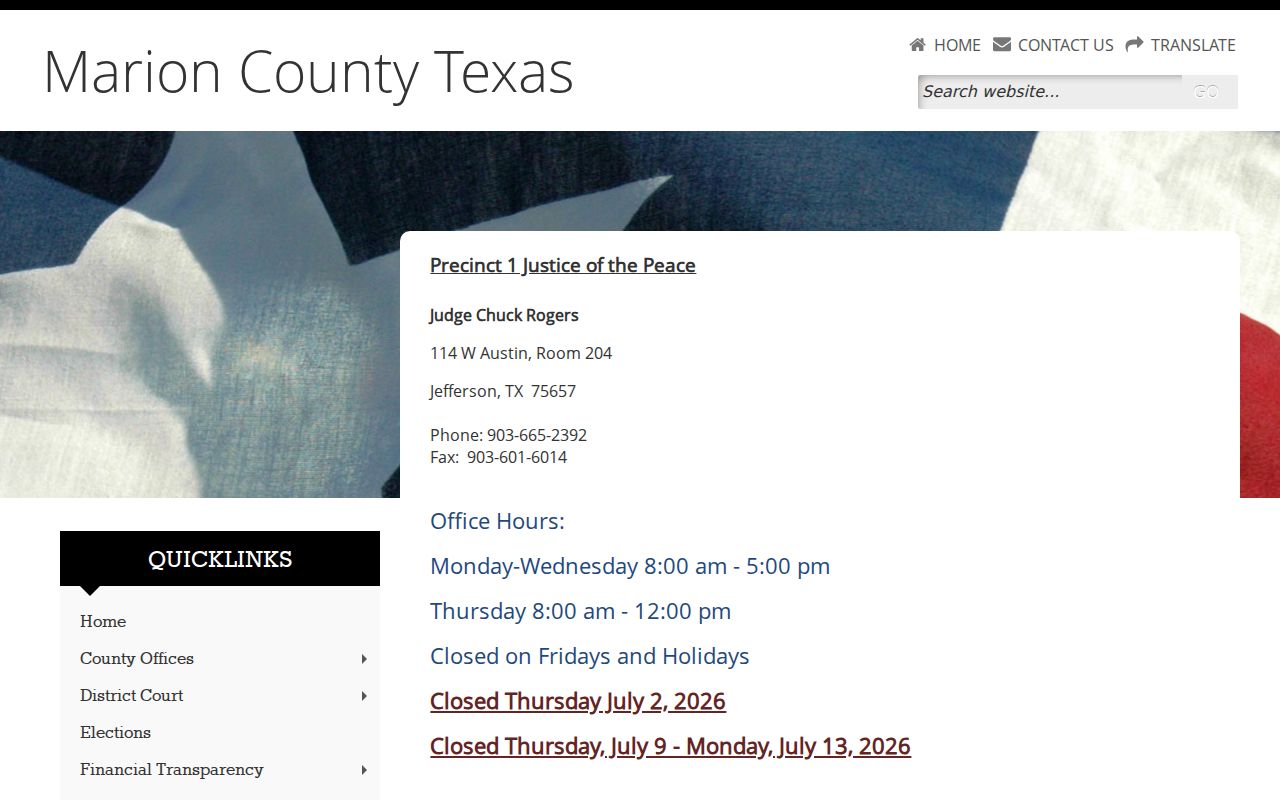
That split prevents a fruitless District Clerk search for a citation that has always belonged to a justice court.
Current fees for plain copies, certified copies, and archived retrieval were not located in the official research. Ask the clerk for the price and delivery options before ordering. A docket sheet is the lowest-risk starting point because it lets the requester choose only the documents needed.
Access & Restrictions
Texas court records are obtained through the clerk and the judicial access framework. Existing county records are generally public under the Texas Public Information Act, but court files also follow court rules, and sealed records are an exception. Confidential juvenile material, protected victim details, personal identifiers, expunged records, and information covered by a nondisclosure order may be unavailable or redacted.
Monthly totals are not person-level dockets. The Marion County court activity reports provide aggregate court context but cannot prove what happened in one cause.
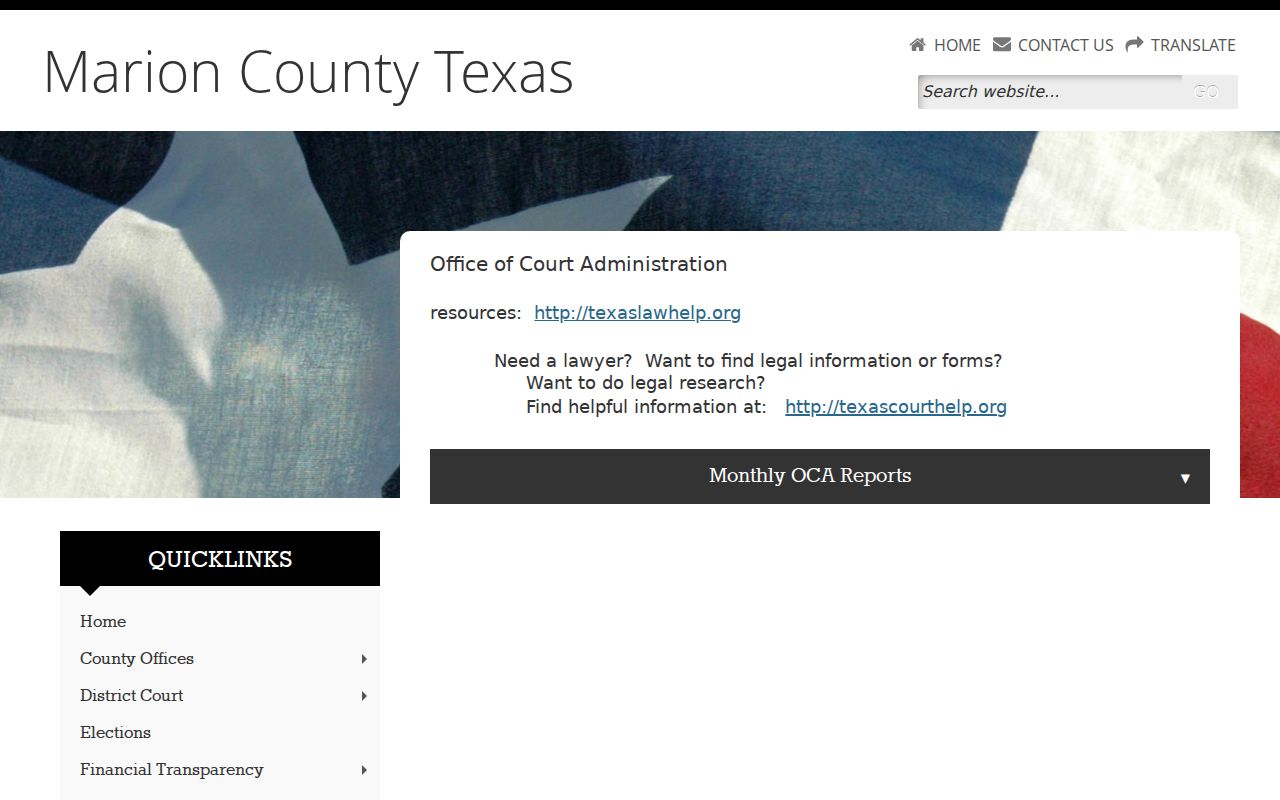
The reports can show court workload, while the clerk's cause file remains the source for a plea, judgment, sentence, or dismissal.
Ask for the narrowest Marion County court record that will answer the question. A cause number and a filing date can save the clerk from searching several people with the same name. If a record is withheld or redacted, keep the request, response, any cost estimate, and the legal exception cited by the custodian. “Public” does not make every field visible, and access to one docket entry does not guarantee access to every attached document. A sealed cause may not appear in the same way as an open file. When a public summary seems incomplete, the sound next step is to ask the responsible Marion County clerk about the file's access status, not to treat the gap as proof of a clean or missing history.