
Running a Sex Offender Check in Marion County
The Texas Public Sex Offender Registry is the main public search channel for Marion County. Texas DPS operates the statewide database at no charge and does not require the paid credits used by the separate DPS criminal-history name search. A name can help identify a person, while a location search can help with community awareness. Compare more than one detail before drawing a conclusion because shared or similar names can point to the wrong person.
Local agencies add a second channel, but their role is registration and compliance rather than a separate online Marion County list. Jefferson Police Department handles qualifying registrants who reside within Jefferson. The Marion County Sheriff's Office handles those who reside outside a municipality. Call the responsible office when the public record seems stale, a move may not be reflected, or suspected noncompliance needs to be reported. For a person or location tied to another state, use the national search after checking Texas.
The official DPS search interface provides the visual starting point for a Marion County registry check.
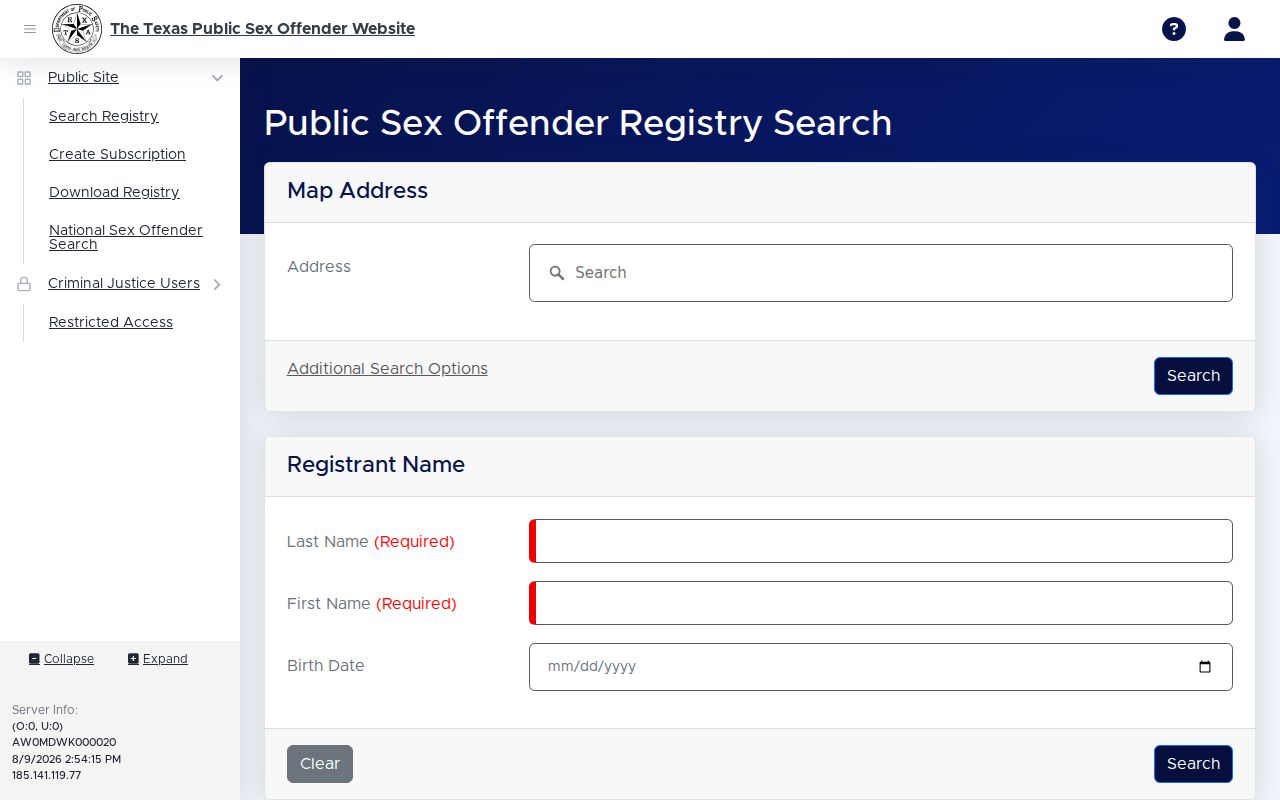
That interface is the authoritative public Texas layer, while the local police or sheriff remains the right contact for residence-based registration questions.
Marion County Sex Offender Registration Offices
Chapter 62 draws the local line by municipal residence. A registrant living in Jefferson reports to the chief-of-police authority through Jefferson PD at 106 N. Alley Street, Jefferson, TX 75657, phone 903-665-2432. A qualifying resident outside an incorporated municipality reports to the Marion County Sheriff's Office at 114 W. Austin, Jefferson, phone 903-665-7201. Jefferson is Marion County's only incorporated city, so this split is especially clear here.
Jefferson Police Department
106 N. Alley Street
Jefferson, TX 75657
903-665-2432
Registration authority for qualifying Jefferson residents.
Marion County Sheriff's Office
114 W. Austin
Jefferson, TX
903-665-7201
Registration authority for qualifying residents outside a municipality.
Neither office published a registration fee, appointment rule, or dedicated registration hours. Call before visiting. Texas requires registration by the later of the seventh day after arrival or the agency's first policy-allowed registration date, so an office's scheduling practice matters to the person with the duty.
Searching the Texas Public Sex Offender Registry
DPS materials confirm that the registry supports searches by name and location. The live interface did not render reliably during Marion County research, so exact field labels, required markers, buttons, dropdown choices, and any radius values should be read from the current screen rather than assumed. The steps below stay within what the official material verifies.
- Open the official DPS registry and read the conditions of use shown on the current interface.
- Choose the available name or location method. For Marion County, use only the place fields the live screen actually offers.
- Review possible matches and compare identity, location, photograph, and other displayed facts instead of relying on a name alone.
- Open the matching public profile, note its status and source, then contact the proper local authority if confirmation is needed.
| Verified Search Concept | Use | What Remains Unverified |
|---|---|---|
| Name search | Find possible records for a known person | Exact labels, required name parts, and matching controls |
| Location search | Search around a known Texas place | Current place fields, dropdowns, map controls, and required markers |
| Historically exposed place concepts | Address, city, county, and ZIP have appeared as search concepts | Which concepts appear now and how each must be entered |
| Radius options | Use only if the live interface presents them | No exact radius list was verified |
There is no verified public email proximity-alert feature for Marion County. Texas SAVNS concerns custody and court-event notifications, not sex-offender proximity alerts, so it should not be treated as a substitute.
Marion County Registry Distance Rules
A map result does not prove that a registered address violates Texas law. Chapter 62 does not set one blanket statewide residence-distance rule for every registrant. A person's supervision conditions may impose limits, and a qualifying local ordinance may impose restrictions under Local Government Code §341.906. Those sources depend on the person and governing jurisdiction.
For Marion County, verify the actual condition or ordinance before making a claim about distance from a school, park, child-care site, or another place. The registry shows public registration information; it does not turn every map point into a legal finding. This distinction helps residents use location information for awareness without misreading a boundary as proof of noncompliance.
Note: A mapped residence is not, by itself, evidence that a Marion County registrant has broken a residence rule.
What a Registry Profile Shows
Chapter 62 and official DPS materials support a defined public set while protecting sensitive details. Read the live profile for the precise fields displayed at the time of a Marion County search. The table stays with supported public categories and the exclusions identified in the statute and DPS guidance.
| Name and Aliases | Identity names reported through the registration process. |
|---|---|
| Photo and Description | Photograph plus supported physical descriptors used to distinguish possible matches. |
| Residence or Detailed Location | The public location information supported by Chapter 62, subject to the person's record and statutory treatment. |
| Offense and Case Facts | Supported offense, conviction, punishment, and victim-age information, without victim identity. |
| Risk and Registration Facts | Texas risk assessment and supported status or supervision information shown on the live profile. |
| Excluded From Public Display | Social Security and driver's-license numbers; home, work, and cell phones; employer details; protected online identifiers; victim-identifying information; and other protected DPS data. |
Juvenile registration may be ordered nonpublic. A public search that does not show a juvenile record is therefore not proof that no registration proceeding ever occurred.
Cross-State Sex Offender Checks From Marion County
Marion County sits in East Texas, where a person's past or current location may cross state lines. The Dru Sjodin National Sex Offender Public Website, commonly called NSOPW, federates searches from participating jurisdictions. Use it when the state is uncertain or when a search needs to extend beyond Texas.
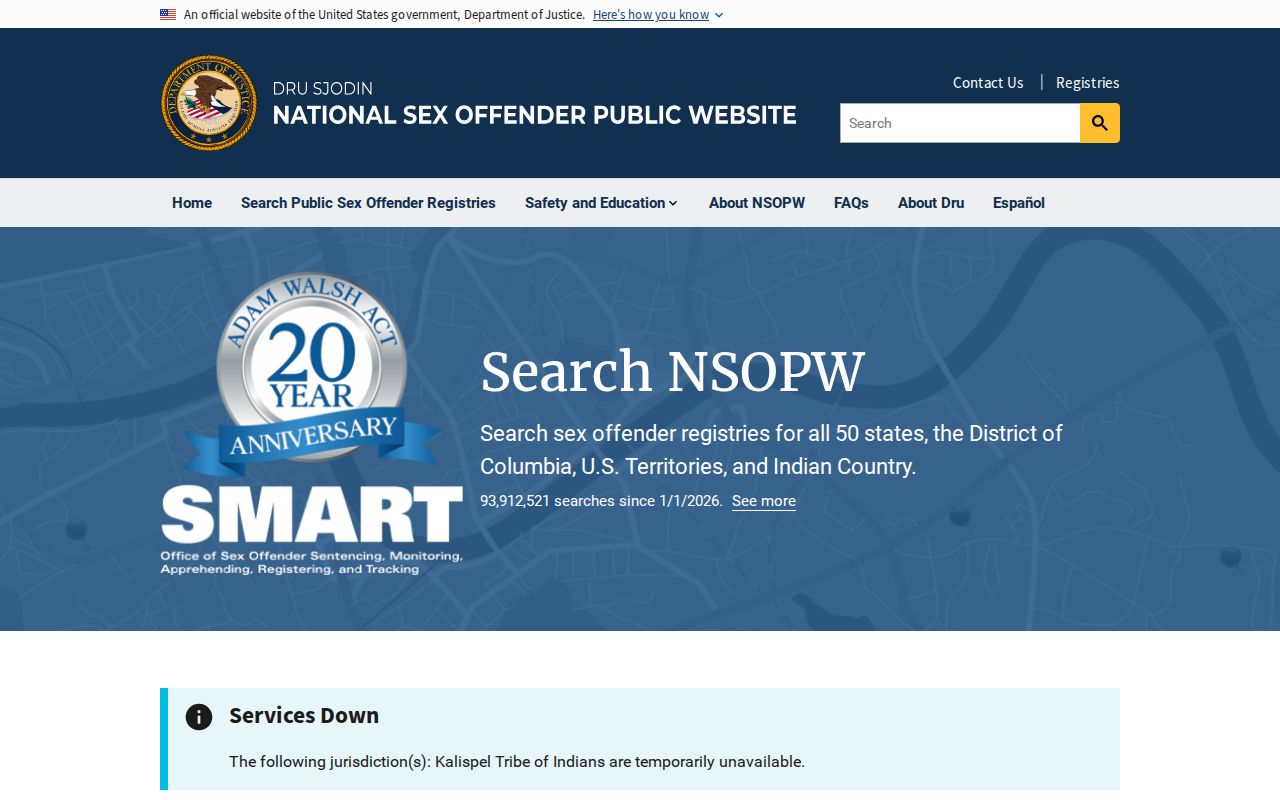
NSOPW adds geographic reach, but the DPS registry remains the primary source for a Texas profile. If the two views appear inconsistent, return to DPS and ask Jefferson PD or the Marion County Sheriff's Office about a local compliance concern based on residence.
Registration Requirements and Levels in Texas
Texas describes risk with numeric levels, not the federal SORNA tier labels. Risk and registration duration answer different questions. The assessment describes danger and the likelihood of continued predatory conduct. Chapter 62 ties duration to the reportable offense, relevant dates, and repeat history rather than to risk level alone.
| Texas Category | DPS Meaning | Duration Relationship |
|---|---|---|
| Level 1 / Low | Low danger; not likely to engage in predatory sexual conduct | Offense and statute control duration, not the level alone |
| Level 2 / Moderate | Moderate danger; may continue | Offense and statute control duration, not the level alone |
| Level 3 / High | Serious danger; likely to continue | High-risk moves can trigger notice, but duration still follows the statute |
| Civil commitment designation | Sexually violent predator under separate intensive treatment and supervision | Statutory or lifetime duties commonly apply |
For adults, the general duration is either life or ten years after the relevant discharge, release, or dismissal date. DPS identifies enumerated sexually violent offenses among lifetime categories. Other adult registrants generally remain registered through the tenth anniversary of the latest relevant date. A juvenile adjudication generally runs until the tenth anniversary of disposition or completion, whichever is later, subject to the statute and court orders.
Marion County Sex Offender Verification Schedules
Verification is not one annual schedule for every person. Civilly committed persons may have to verify every 30 days. A person with two or more sexually violent offenses may have a 90-day schedule. Many other registrants verify once each year. The proper frequency comes from the registrant's Chapter 62 category and governing orders, not from a guess based on the public risk label.
| Registration Circumstance | Possible Verification Schedule | Local Office |
|---|---|---|
| Civil commitment | Every 30 days | Jefferson PD in the city; Marion County Sheriff outside a municipality |
| Two or more sexually violent offenses | Every 90 days | Agency determined by residence |
| Many other registrants | Annually | Agency determined by residence |
Failure to comply is a felony under Code of Criminal Procedure article 62.102. Report suspected noncompliance to Jefferson PD for a Jefferson resident or to the sheriff for a qualifying resident outside the city. Give the agency specific, observable facts rather than confronting the person.
High-Risk Registry Notices in Marion County
DPS may mail community postcards when a high-risk registrant or a civilly committed sexually violent predator enters a community. Local authorities also notify schools when Chapter 62 requires it. This program is different from an opt-in email alert, and Marion County research found no verified public email proximity-alert signup.
The DPS registration program overview explains the state's registration and community-notification framework.
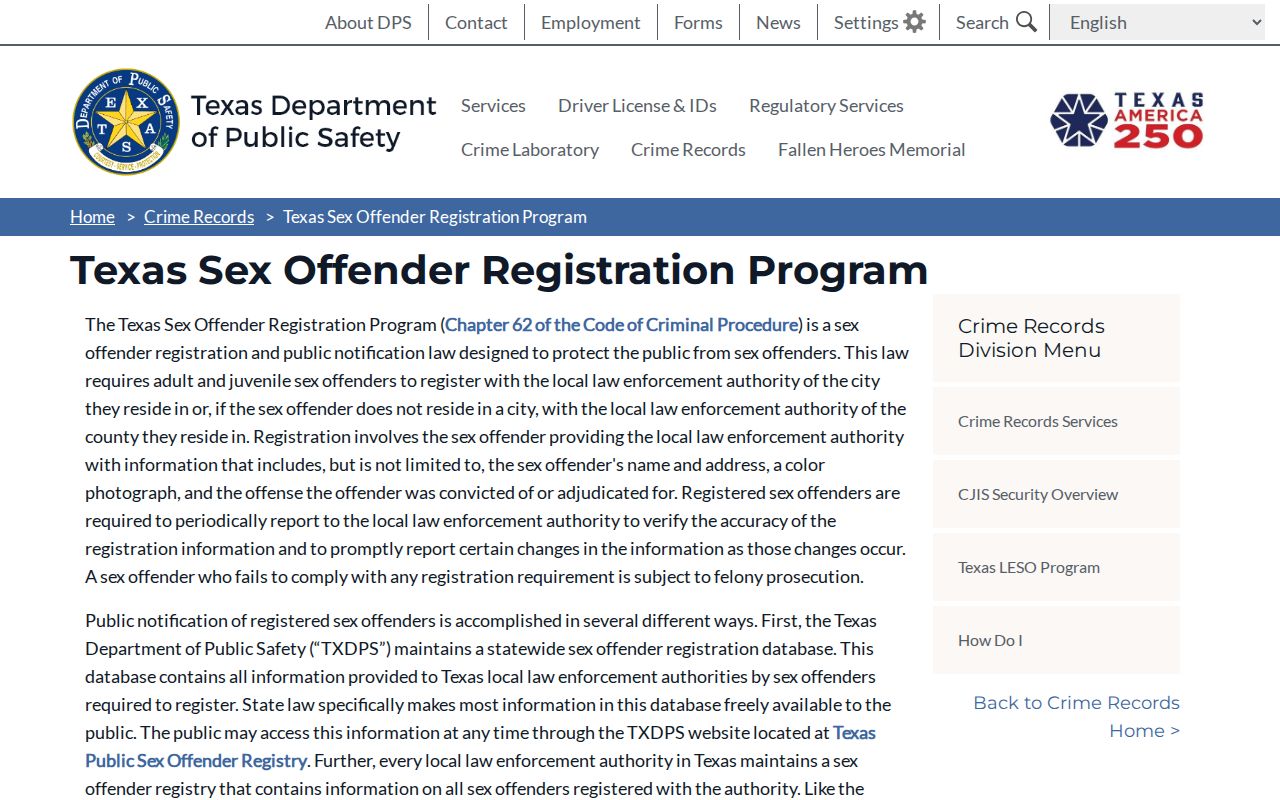
That official program layer explains why a mailed notice and a public profile serve related but distinct roles. For current facts, search the profile directly and confirm a local compliance question with the residence-based agency.
Lawful Use and Community Notification
Registry access supports personal, family, and community awareness. Read the official profile, use the correct local contact, and keep the information in context. A profile does not authorize trespass, threats, surveillance, or a personal compliance investigation. If a Marion County record suggests a missed move or another breach, send the facts to Jefferson PD or the Marion County Sheriff's Office based on where the person resides.
Registry misuse is unlawful: Texas Code of Criminal Procedure Chapter 62 governs public registration information and community notice. Do not misuse that information to harass, threaten, trespass, discriminate unlawfully, or commit another crime.
Community notification also has limits. A high-risk postcard reflects the statutory notice process, while the absence of a postcard does not erase a registry duty or guarantee that no profile exists. Search the DPS registry directly for current public information. If safety is at immediate risk, contact emergency services; otherwise, route suspected registration noncompliance to the responsible local agency.